
Success in the 1920s Golden Age of Automobiles
The Hudson-Essex dealership reflected the city’s growing wealth and automobile boom until it was forced to close because of the coming Great Depression. The Hudson-Essex dealership mirrored the city’s burgeoning wealth and automotive boom until its closure due to the looming Great Depression.
The A.E. The England Motorcar building is an automotive dealership built in 1926 along Central Avenue in downtown Phoenix—what would become known as ‘Auto Row. A. E. England built the building as his Phoenix dealership for Hudson-Essex cars. Hudson and Essex brands were very popular all over the U.S. in the 1910s-20s, especially around Phoenix and outlying areas where there were rich entrepreneurs apparently flooding the region in the first part of the twentieth century.
The rise of the automobile in Phoenix and America came in the latter half of the 1910s when more brands of automobiles became not only available but also affordable and attractive to upper, middle, and lower-middle-class Americans. Phoenix’s financial success contributed to the automobile’s popularity and use in the area. Improvements such as paved roads were made possible by the implementation of the 1916 Federal Aid Road Act, which provided federal funds for road building. From the period before the First World War through the early 1920s, Phoenix saw a boom of wealthy businessmen moving to the area. “Auto production increased from about 4,000 vehicles in 1900 to more than 1.9 million in 1920,” which shows the large market that was there and created opportunities for dealers like A.E. England to supply the great demand. In Maricopa County alone, there was a rise in auto registration of 15,767 automobiles from 1925 to 1930. Agriculture in Phoenix was booming because there was an intense need for foodstuffs in Europe due to the devastation of the First World War, and companies such as Goodyear would flourish from both European and federal contracts to aid the war effort and supply goods after the war, which helped supply the region with wealthy entrepreneurs. The growth of wealth in America helped power auto culture. Arizona has a dramatic and picturesque landscape that attracted automotive tourists and increased demand for automobiles within Arizona.
A.E., July 30th, 1926, was the opening night for England Motorcars, a Hudson-Essex automobile dealership, and it was a party atmosphere, according to the Arizona Republic. Mr. England paid $75,000 for the lot and to build the building, which today would be roughly $1.06 million. The company made Hudson and Essex cars. These were popular mid- to high-end luxury cars. Essex was the mid-priced brand and Hudson the high-end brand. When A.E. England launched his auto row location. The Hudson-Essex models ranged from $660 for the lowest-priced Essex to $1,165 for the Hudson. The Ford Model T line cost $260 for the lowest-priced option and $660 for the top-of-the-line option. In 1928, Hudson-Essex sold more new vehicles than any other automaker in Arizona, with 877 vehicles registered in Arizona that year. This indicates the popularity of the Hudson-Essex brands in Phoenix in the 1920s but also the immense wealth that had accrued in the area to back up such sales over cheaper auto brands.
When A.E. The England Motorcar building was built and started business in 1926, the automobile market in the U.S. was approaching its wartime peak. U.S. auto supply started to outpace demand in the late 1920s. So with the hard economic times of the Depression, more and more dealerships began to buy and sell used automobiles to survive. Arizona was spared the Depression to a greater extent than the rest of the U.S., but on October 19, 1930, the dealership of England announced that it would cease to operate. The Arizona Republican, a Phoenix-based newspaper, published England’s statement that he “sold [his] entire stock of Brand New Hudson and Essex Automobiles to J.A. Herzog, who takes immediate possession. ” This leaves him with no stock of these cars.”
A. E. England’s tenure lasted just four years, but the impact of his Hudson-Essex dealership was felt throughout Phoenix and Arizona as the brand’s success was virtually unequaled in the late 1920s, thanks to A. E. England’s dealership construction. The success of this dealership in Arizona was in part due to the wealth that coursed through the region in the early twentieth century, and in part it was due to the popularity of the brand and its messaging of such popularity. The A.E. is presently (2019) owned by Arizona State University. England built and uses it as a civic space for meetings, classes, art events, and banquets.
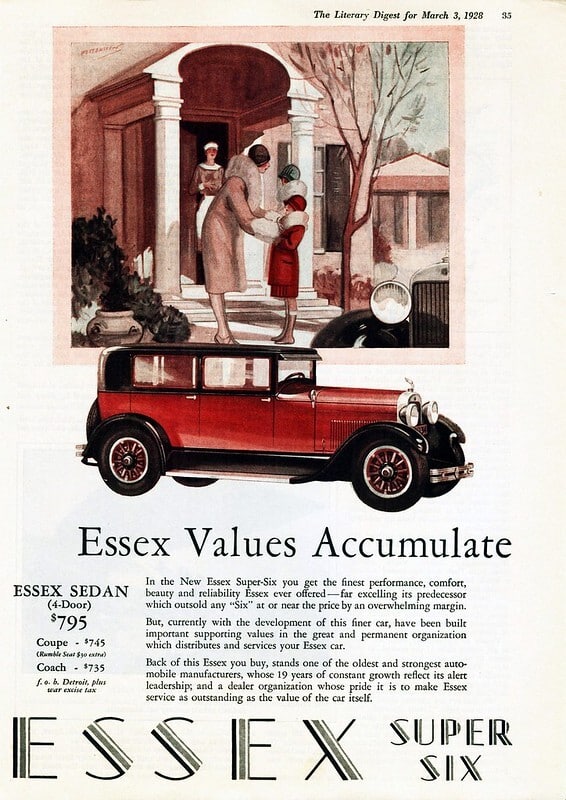
1928 Essex Super Six
Essex: advertising that represents upper-class luxury with a middle-class price. The Essex Super Six gives the customer the looks and performance of a more expensive Hudson Super Six with a much lower price. The main differences are in the interior, where the Essex only gets the necessary gauges and base-level trim options as opposed to the intricate and elegant interiors found in the Hudson models. Source: Jewell, Alden. “1928 Essex 4-Door Sedan.” Posted July 21, 2010. Accessed Dec. 2, 2019. Date: 1928
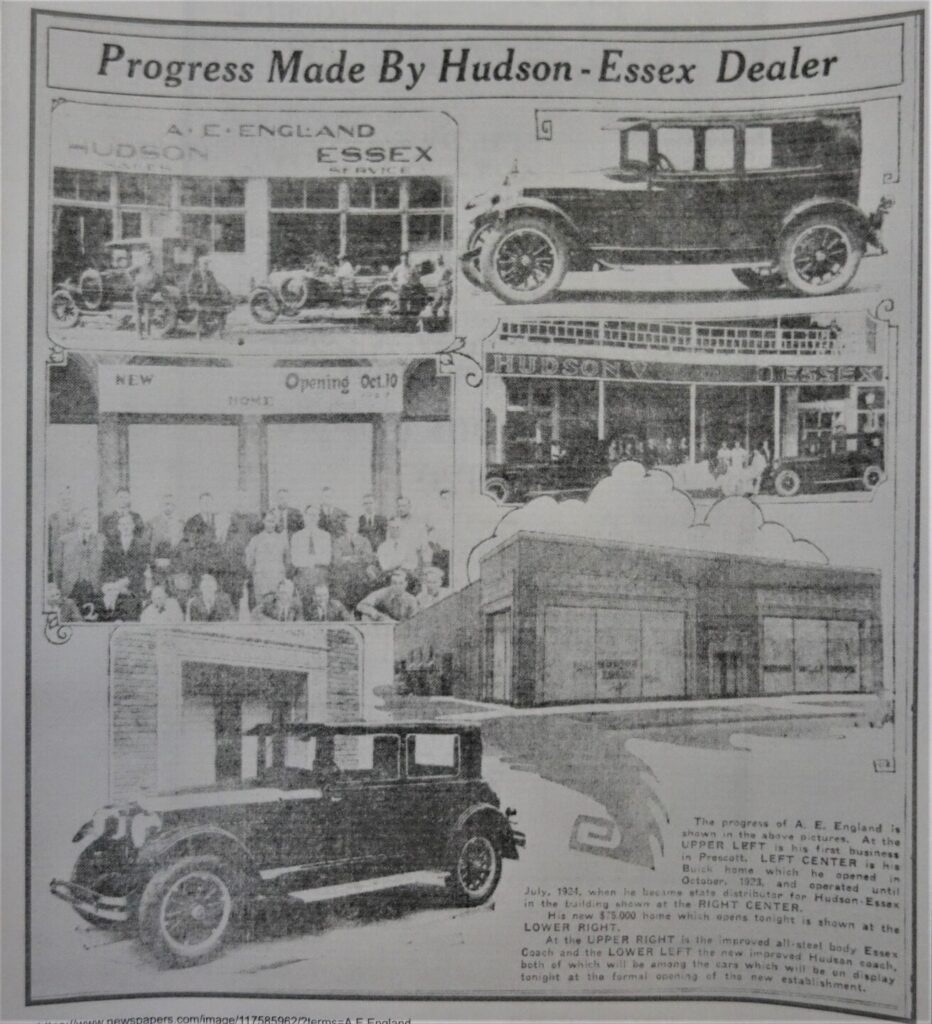
A. E. Hudson-Essex Dealership Opens in England! This is one of the pictures used by the Arizona Republic to announce the opening of the new A.E. Hudson-Essex dealer in the UK. The image shows England’s Tucson dealership and an artist’s conception of the new Auto Row dealership, with a 1926 Hudson at the bottom left of the image and a 1926 Essex at the top right of the image. Source: “Hudson-Essex Dealer Makes Good.” Arizona Republic [Phoenix] 30 July 1926: Sec. 3, p. 17.
Date: 01-01-1926
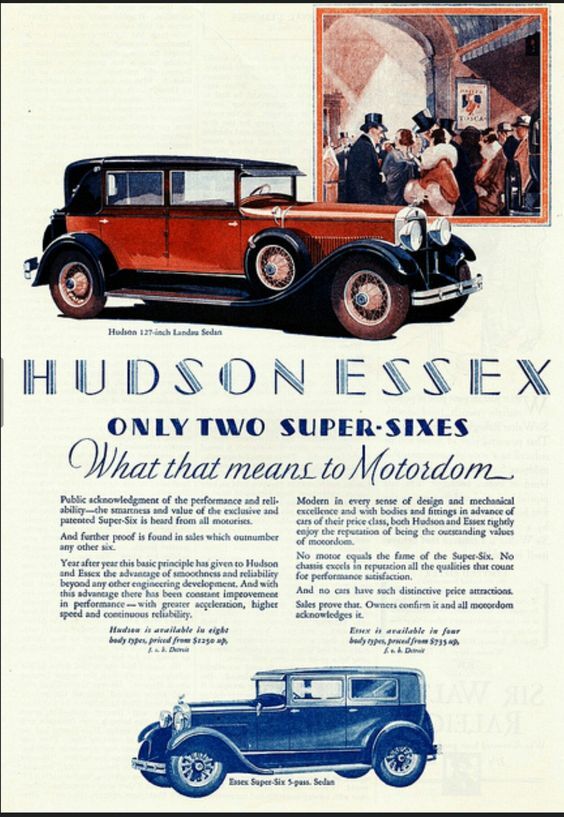
Upper-Class Luxury, Middle-Class Prices
Advertising the Hudson 127 Landau Sedan, one of the more expensive and luxurious Hudsons, and also the Essex Super Six 5 Pass Sedan, a less expensive model. Hudson-Essex advertising often tries to show that these cars are upper-class cars but affordable for middle-class people. Jewell Alden, creator. “1928 Hudson and Essex Super-Six Sedans,” posted Nov 28, 2012. Date: 1928. Accessed 1 Nov. 2019. 1928.
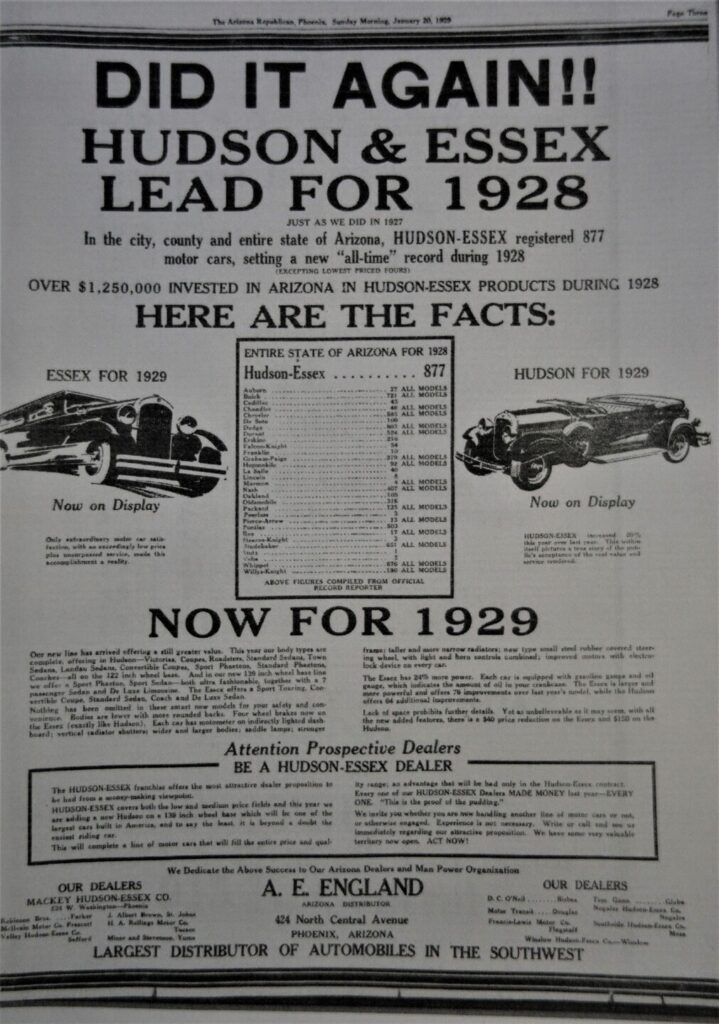
Hudson-Essex Strikes Once More! This advertisement gives sales figures to support the claim that the Hudson and Essex brands were the most sold automobiles in Arizona in 1928, with a total of 877 new Hudson-Essex vehicles out of 7,549 total new registered vehicles sold by the 31 different manufacturers selling automobiles in Arizona. Creator: “Did It Again!! “Hudson & Essex Lead In 1928.” The Arizona Republican [Phoenix] 20 Jan 1929: 3.
Date: 1929-11-22
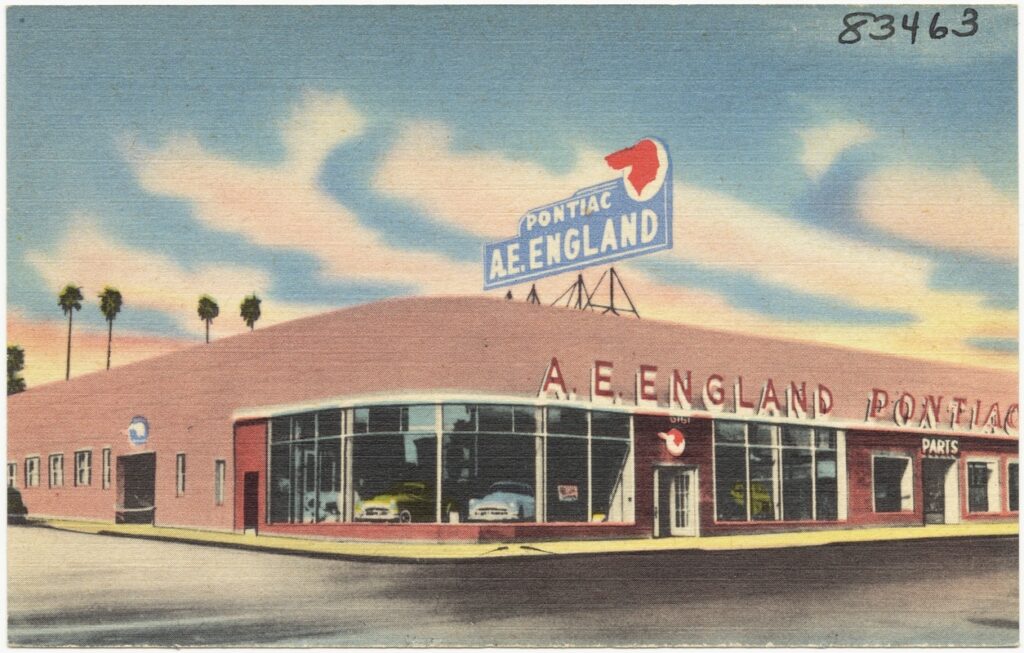
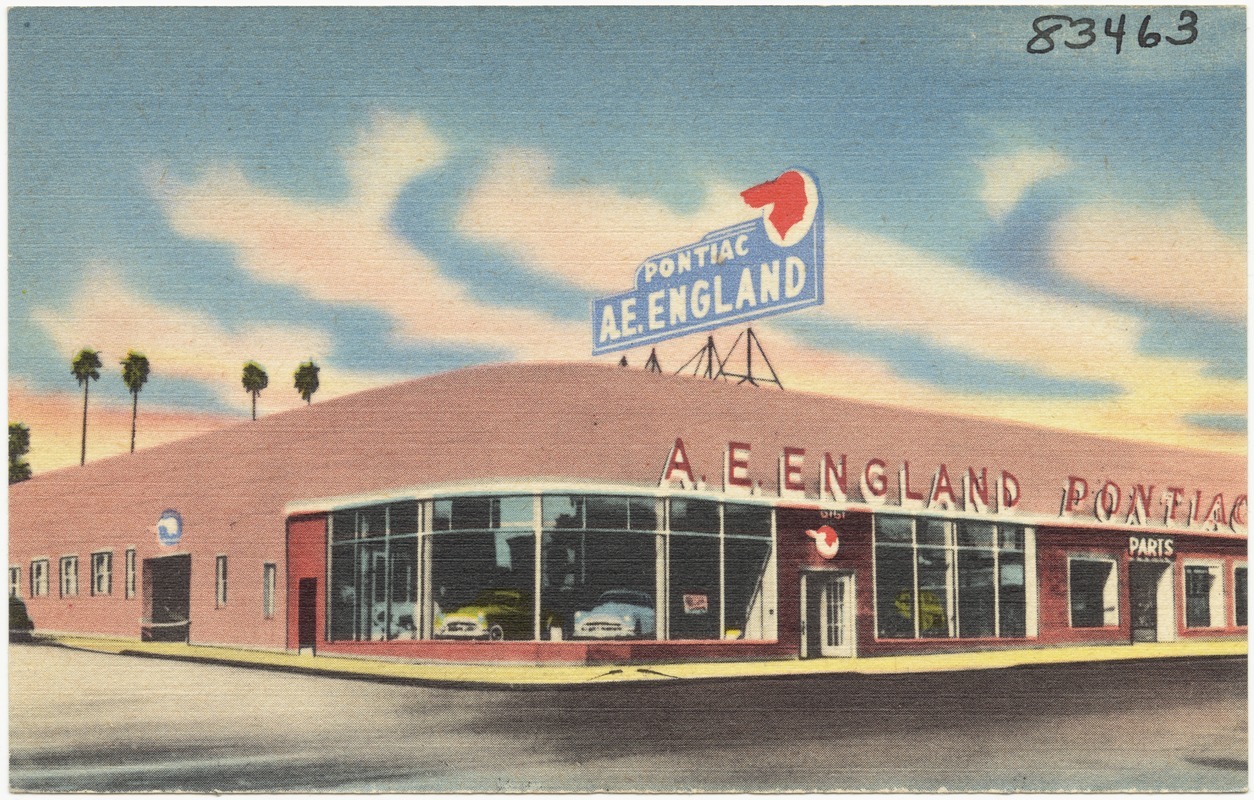
A. E. Pontiac dealership in LA, England
After England left Phoenix and sold off his fleet of Hudson and Essex vehicles in 1930, he opened a Pontiac dealership in Los Angeles sometime in the early 1950s, some 20 years after he ended his venture in Phoenix with his Hudson-Essex dealership. His Pontiac dealership was on Hollywood Boulevard, and the building is still there, also known as A.E. Construction England. Author: Pontiac, A.E. England. Card. Digital Commonwealth, last modified Dec 03, 2019.
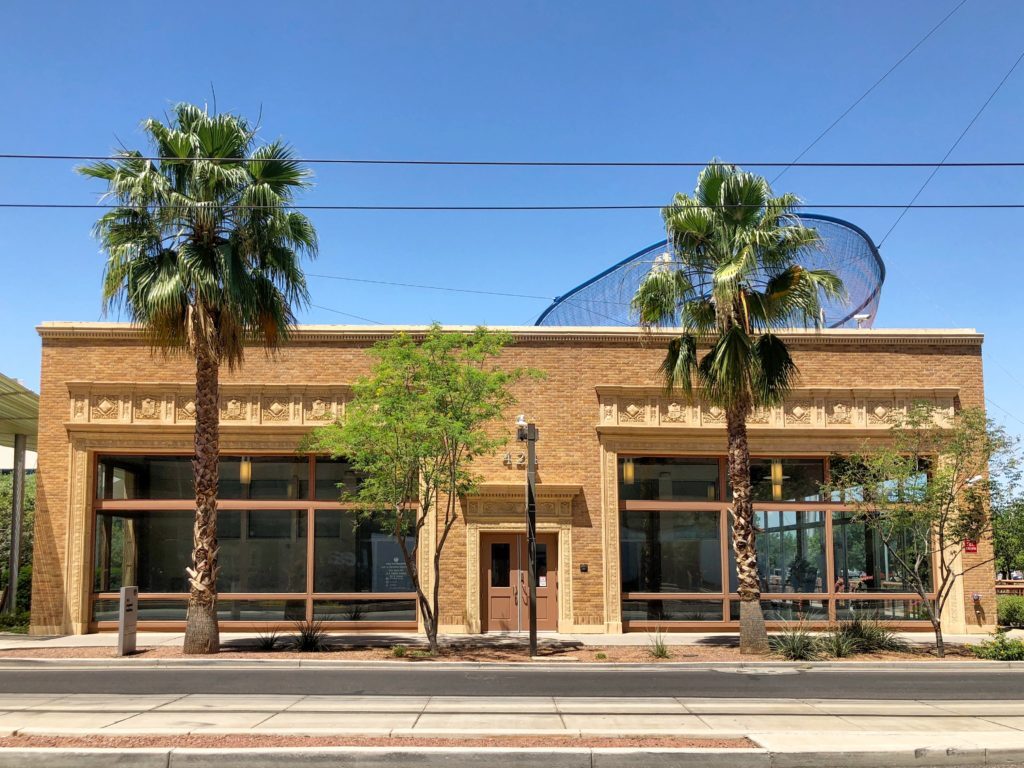
A. E. England Build Today
The building is now owned by Arizona State University and is used as a civic space to host galleries, banquets, lectures, and other public events. Tours of the building are available by appointment through ASU’s website. Author: Lauren Potter. “7 Downtown Treasures to Celebrate Historic Preservation Month.” May 18, 2018. Accessed December 2, 2019.